
Managing Your Personal Forest
A practical framework for tending your time, attention, and energy

1603 words/ 7.5 minutes. 3 Questions Deep is planting seeds of curiosity that will grow and reseed, spreading waves of wonder, understanding, and cooperation for future generations.
Consider subscribing for a weekly article focused on the power of questions in an uncertain world.

Time is the visible constraint, but attention is the governing currency; it decides what grows in your forest and what quietly withers.
Manage Your Personal Forest
You’ve probably made a big life decision by getting locked onto one aspect — money, time, or a malfunctioning schedule. So have I.
Each person’s life is a nuanced, individual forest — money, time, health, family, work, and perception, all interacting and growing together. Manage one group of trees and ignore the forest, and you can “fix” one problem while fungus and disease quietly damage other parts.
Two of the most mismanaged and misunderstood in that forest are time and attention. Before we discuss what happens when you manage the wrong one, it helps to see why time itself is such a slippery thing to manage in the first place.
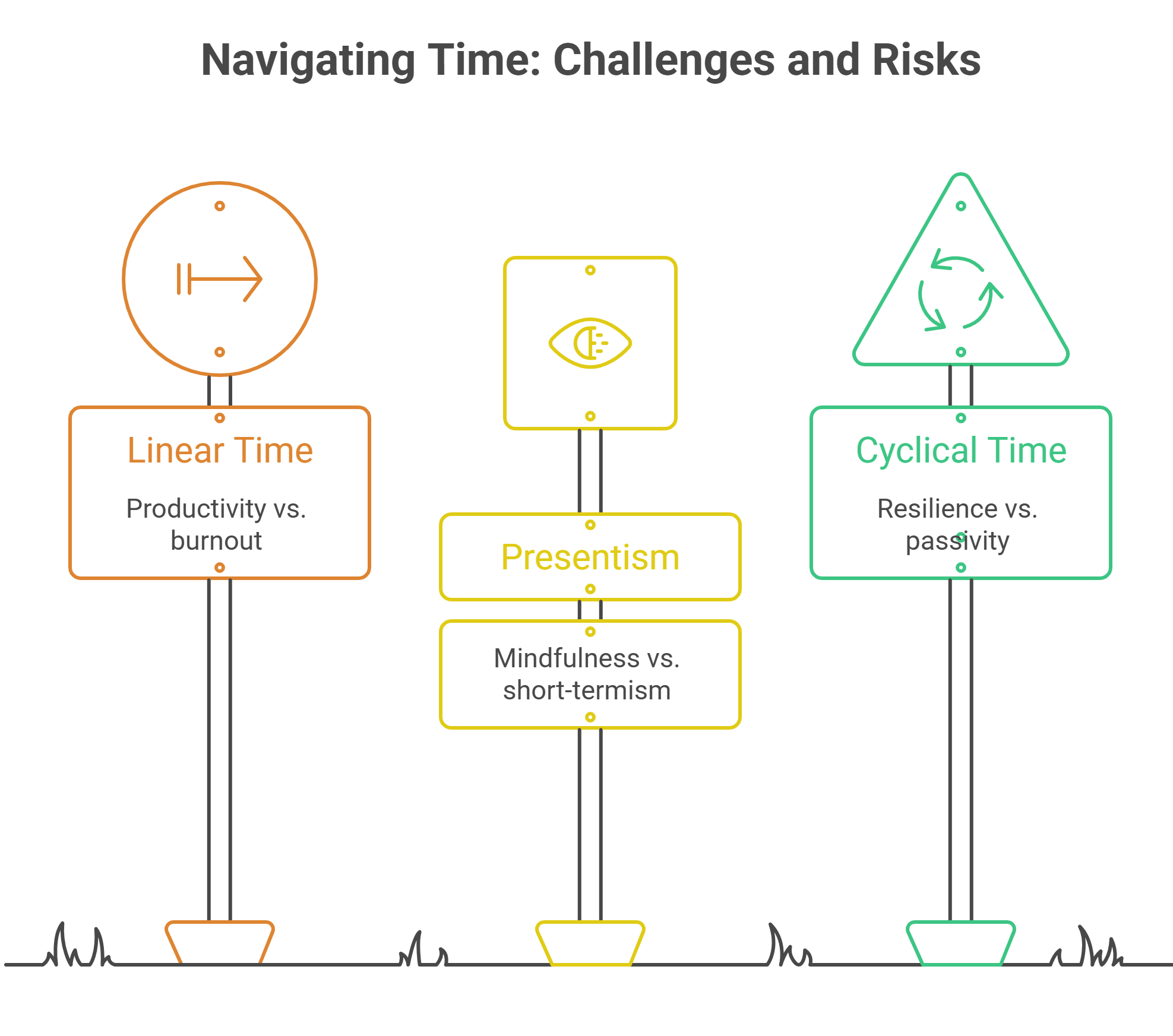
How we perceive time quietly shapes our habits, anxieties, and sense of purpose. Below are 3 popular perspectives on time that circulate in everyday Western thought, each with a risk and a benefit for someone trying to manage their forest.
Linear/clock time
Time flows one way, is measurable and scarce
Dominant everyday default
Benefit: Productivity, planning
Risk: Burnout, urgency
Presentism
Only “now” exists
Popular for intuitive people
Benefit: Present-moment mindfulness
Risk: Short-term planning/thinking
Cyclical time
Time repeats in patterns/seasons
Popular in wellness/spirituality culture
Benefit: Patience, resilience
Risk: Passivity
None of these views are mutually exclusive.
Most people in Western societies operate at the intersection of several at once. For example, running a strict work calendar on weekdays, then practicing meditative presentism on weekends.
This layering is itself a defining feature of modern life.
Time vs. Attention
Time and attention are different trees in the same forest.
We manage time through scheduling.
Attention requires protecting focus from distraction and fragmentation — a mindfulness-and-prioritization problem, not a calendar problem.
Think of time as the container and attention as the water you pour into it. You can have an empty hour and still spend it distracted, and you can have ten minutes of real presence that outperforms it.
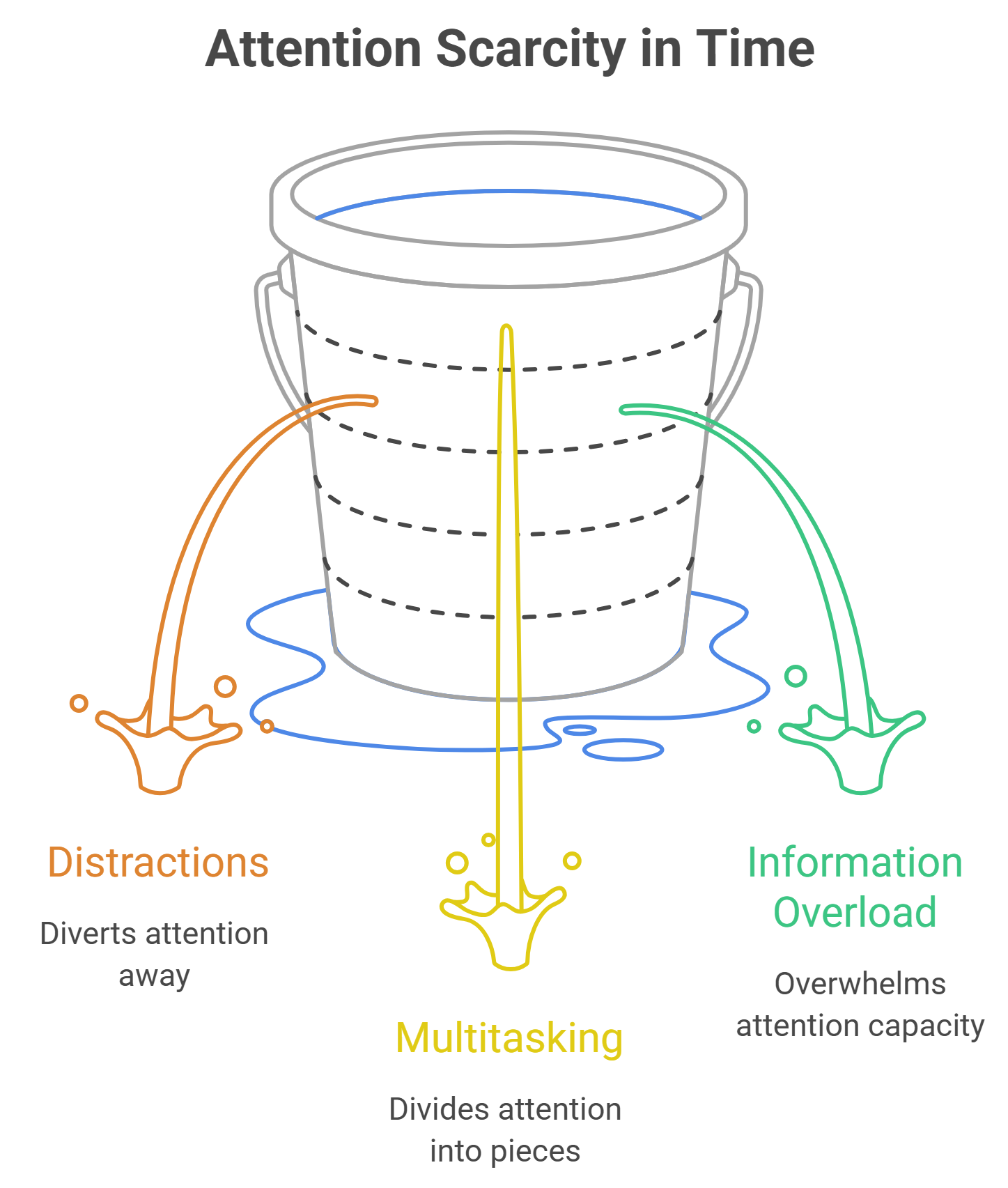
Being in a meeting while preoccupied with a problem at home is an everyday example.
Social media is the most aggressive version of the same trap deliberately built to be habit-forming, because your attention is the product being sold to advertisers.
Caring for your forest means learning to spot attention-draining fungus on your trees.
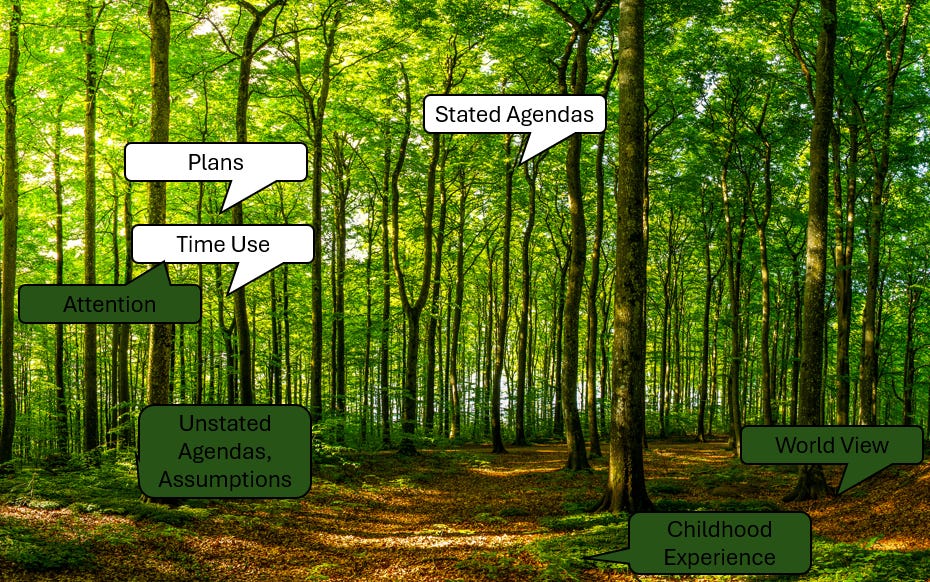
Life is nuanced, layered, and not always obvious. Status, comparisons, systems, childhood patterns, assumptions, and unstated agendas may blend in with the forest, as displayed above.
The C→A→R Route is designed to help you understand your personal forest, with its groups of trees and down to individual trees. It helps you see and understand the important parts of yourself that quietly blend in so you make better choices.
The C→A→R Route
The C→A→R Route helps you see your forest clearly enough to manage it, instead of fixing one tree while a bigger one falls over behind you.
Clarify — what’s actually being decided, stated plainly
Assumptions list — the premise of the “obvious” choice
Review — the evidence behind each assumption, and how solid it actually is.
The example below is built to illustrate how a family could use the C→A→R route. The numbers and trade-offs are the kind families may face.
The Situation
A single mom in Cleveland, 36, makes $52,000 a year.
Her 9-year-old son goes to a struggling neighborhood school.
A better charter school is available for a $6,800 “family contribution.”
A call center offers her evening shifts, 15 hours a week, worth about $11,000 a year after taxes — enough to cover tuition with room to spare, on paper.
Everyone around her says the same thing: take the shifts, get him into the better school, the sacrifice is worth it.
Sounds obvious, but life is nuanced. Continue following the C→A→R Route. Remember, everyone does not live your life; you do. What may work for one family may not for yours.
Clarify the plan.
“School quality is the biggest lever right now.” It will help him more than anything else.
The second job will cover the added school costs with extra.
Her mother currently covers that gap from 3 to 6 p.m.
List the assumptions.
“School quality is the biggest lever right now.”
“$11,000 minus $6,800 leaves real breathing room.”
“Grandma’s help will hold steady.”
“My son will understand the trade.”
Binary choice: “It’s this job, and this school, or nothing changes.”
Review the Assumptions Rigorously
“School quality is the biggest lever right now.” For a kid already on grade level, a better school may help a little.
Her son isn’t actually behind — he’s on grade level in reading, slightly ahead in math.
What he’s missing may not be a better school. It may be a reliable adult around during homework and evenings.
Stable home life and steady time with a parent may help a lot more at this age.
“$11,000 minus $6,800 leaves real breathing room.” Let’s do the math — as an illustration, not a precise forecast:
Added cost from evening shifts - Illustrative estimate
Gas/transit for the commute ~$750/year
Quick meals or takeout on shift nights (3 nights/week) ~$2,000/year
Backup childcare for evenings grandma can’t cover ~$1,000/year
Subtotal of added costs ~$3,750/year
Shift income $11,000 minus tuition $6,800 minus added costs $3,750 equals $450/year “breathing room”
The “breathing room” can evaporate once you price in the actual cost of being out of the house in the evenings.
The math does not support this assumption
“Grandma’s help will hold steady.”
Her mother currently covers that gap from 3 to 6 p.m., but she’s 71 and starting to slow down. Relying on it long-term is risky.
“My son will understand the trade.”
He likely won’t experience it as “Mom is working nights so I can go to a better school.” He’ll experience it as Mom isn’t home at night.
“It’s this job, and this school, or nothing changes.”
This is the assumption that turns a real decision into a false binary. Before accepting evening shifts, it’s worth checking:
Does the charter school offer income-based tuition assistance or a payment plan?
Does the current school he’s in have any additional opportunities to help him advance?
Is there a father, aunt, uncle, or neighbor who could share evening coverage instead of hiring backup care?
Could she take fewer hours — say, two shifts instead of three — and close a smaller tuition gap instead of the whole $6,800?
None of these get explored if the choice is framed as “take the job or don’t.”
The C→A→R Conclusion
The question is: does this specific trade get her what she thinks it gets her?
Being away from home in the evenings, and losing a parent’s steady presence, may cost the family more in stability than the modest academic upside the better school would add.
The financial cushion disappears once the real costs of evening work are priced in.
The choice that looked settled at the start may be dropped, or the additional options uncovered during the assumption review can be explored.
Use the C→A→R Route in your own forest before treating any “obvious” trade-off as settled.
3 Questions to Ponder This Week
Did I choose this reference point, or was it handed to me?
If it was handed to you, that’s a red flag.
When you plant one tree in a forest, it impacts the forest around it.
Try replacing ‘Can I fit this in?’ with ‘What will this displace if I do?’
What stories are outdated?
Try composting Old Stories to Fertilize Your Next Chapter.
3 Quotes to Ponder This Week
“It is our choices, Harry, that show what we truly are, far more than our abilities.” - J.K. Rowling, Harry Potter and the Chamber of Secrets
“I think one of the greatest luxuries isn’t owning more.
It’s having enough time to cook dinner without feeling hurried.
Time might be the most valuable ingredient in any recipe.” - Danielle Jerace Just Danielle“Every meeting spends attention.
Every decision spends judgement.
Every crisis spends capability.
What restores them?” - Peter Ashby Smith Peter Ashby Smith The System Must Give Something Back
Summary
Your life is a forest, not a single tree: if you focus on optimizing one dimension (like money or time) in isolation, you can quietly damage more important areas such as attention, relationships, and stability.
Time and attention are different but intertwined: time is the container, attention is the quality of what fills it; managing only your calendar while ignoring where your focus actually goes leads to distorted trade-offs, especially in a distraction-heavy environment.
The C→A→R Route (Clarify → Assumptions → Review) is a practical framework for unpacking life situations large and small.
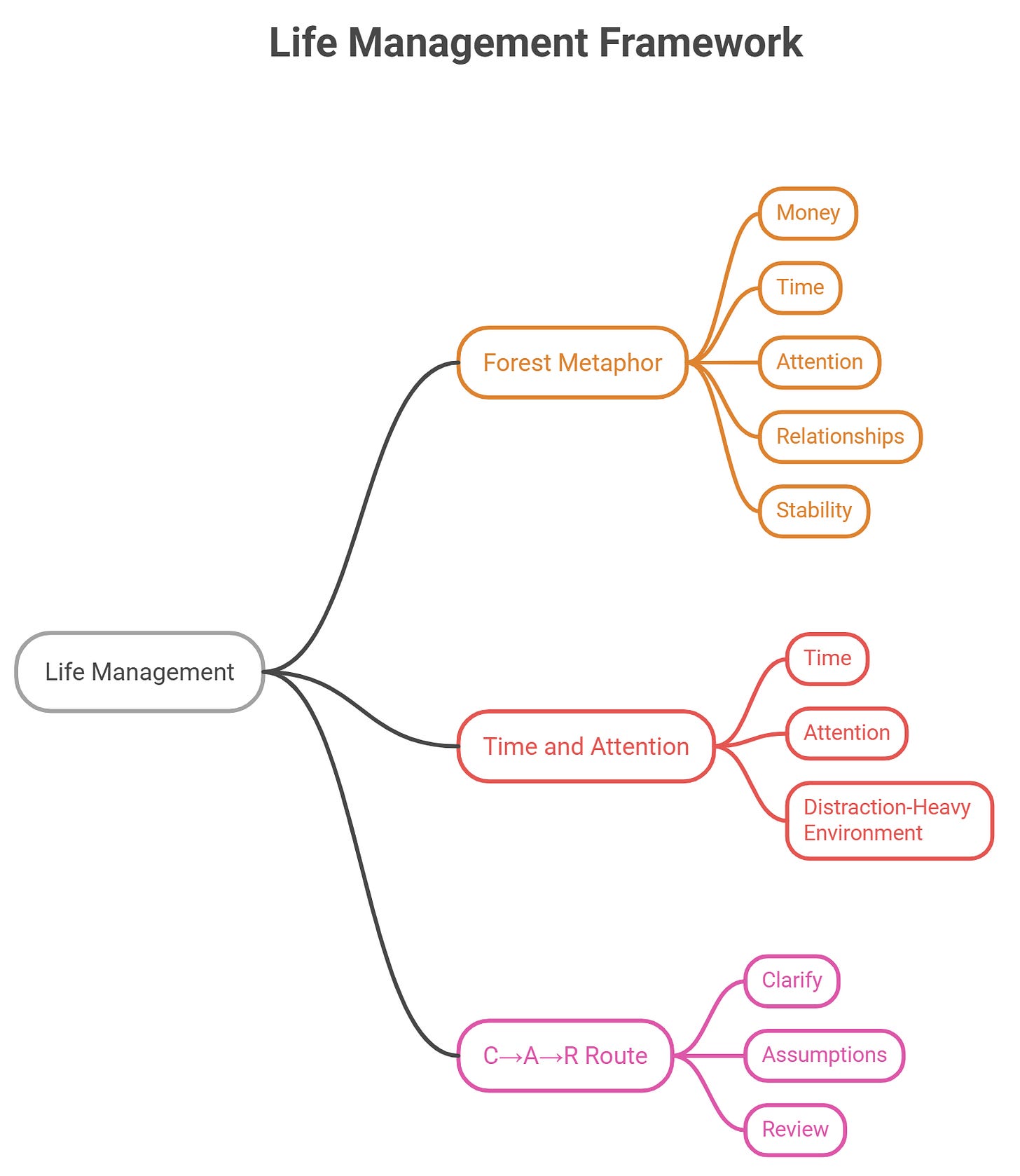
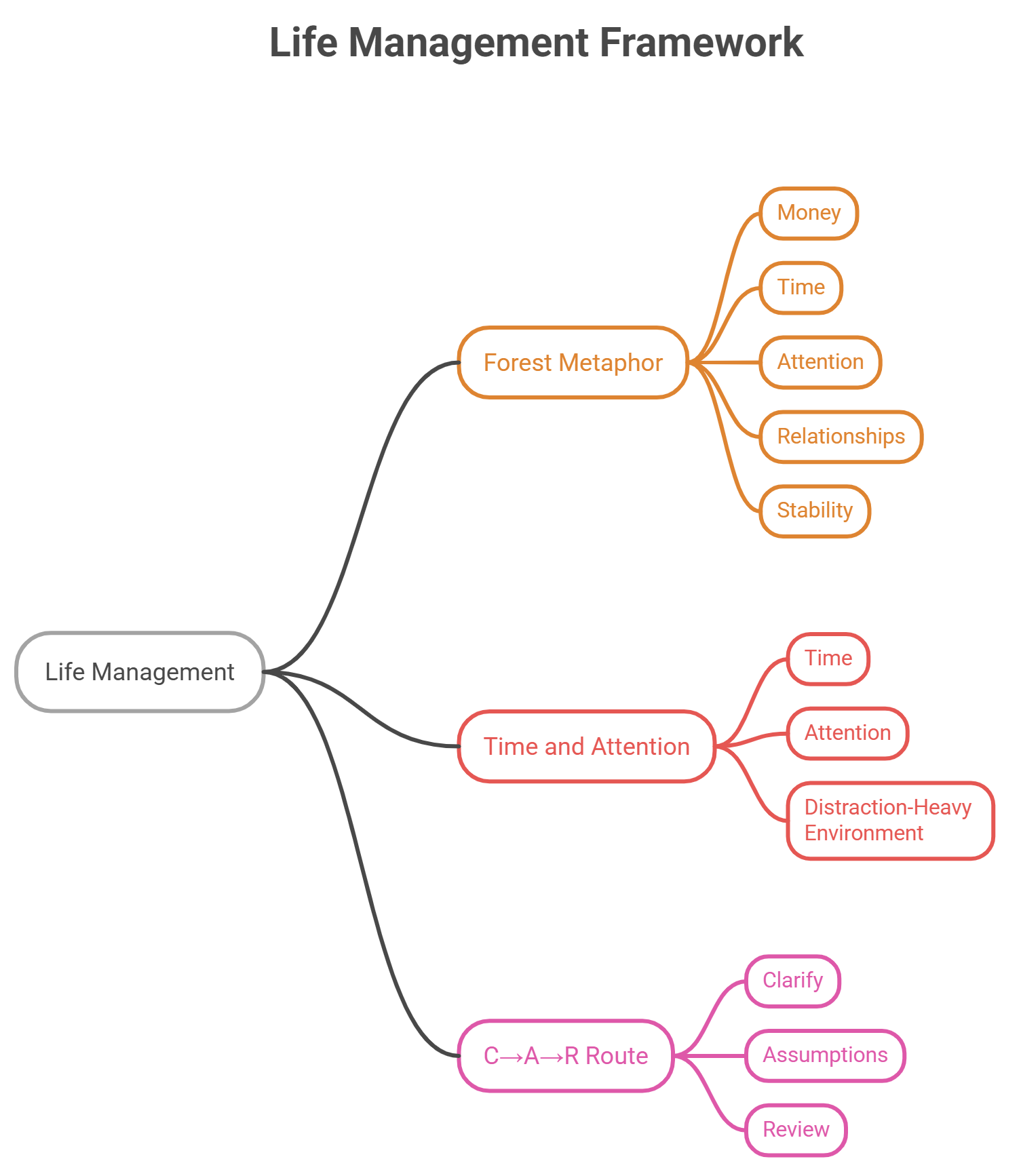
Clarify, list assumptions, review them ruthlessly: the C→A→R Route is the habit of refusing to let an ‘obvious’ answer rearrange your entire forest in secret.
The 3 Questions Deep Team
At 3 Questions Deep, we are planting seeds of curiosity that will grow and reseed, spreading waves of wonder, understanding, and cooperation for generations to come.
Thanks for the quote. The post was a great read too. 👏
Jim, the C→A→R Route hits something mid-career leaders miss constantly: we optimize the one tree everyone’s pointing at, then wonder why three others are dying behind us. I see it in leadership decisions all the time: someone takes the promotion because “obviously,” never checking if the assumption underneath even holds. Your line about attention being the governing currency, not time, is the whole game.