
Three Questions Deep: Exploring The Financial & Career Areas
Applying the 3 questions "Clarifications → Assumptions → Reasons" to financial & career issues


About 1350 | 6-7 minute read
The best questions don’t challenge belief just for sport; they force you to think through it clearly — to either double down with reason or discard it as folly.
People pick up money and career advice early — from parents, teachers, or anyone who sounds wise. Things like:
“Work hard and you’ll get ahead.”
“Do what you love and the money will follow.”
“Follow your passion, and success will come.”
These sayings stick around because they sound right and have worked for some.
But the mistake is treating them like laws of nature instead of checking if they fit your situation. What worked for one generation may flop in another. Curious people test their beliefs, not just inherit them. That’s what the C→A→R (Clarifications → Assumptions → Reasons) method is for — not tearing down ambition, but making sure your rules for success actually make sense for you.
After all, decisions about money and work steer your whole life. If you never question the advice driving them, you might be following someone else’s map.
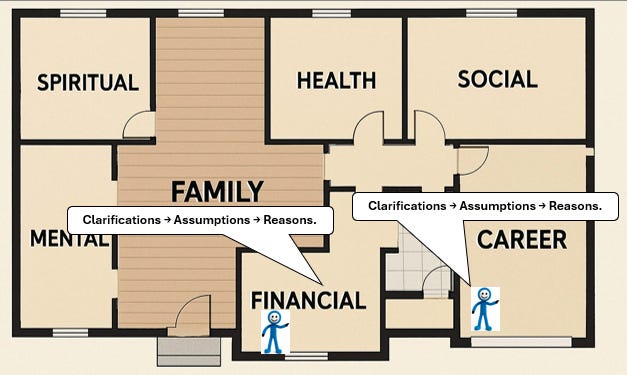
Examining the Financial & Career Area of Life
The C→A→R (Clarifications → Assumptions → Reasons) method forces you to inspect your own thinking before you get tangled in judgments. Instead of rushing to label a belief as right or wrong, slow down and dissect it.
Start by: clarifying what you actually mean —> then uncover the assumptions you’re standing on —> finally examine the foundation your conclusions rest upon.
You can’t think well if you don’t first see your own mental machinery clearly.
Example One
“You have to work hard to make money.”
Clarification: let’s dissect this.
What counts as ‘working hard’ here?
Long hours
Intense focus
Physical labor
Emotional output
Creative effort
Some combination of the above
What threshold of ‘making money’ are you referring to?
Survival
Comfort
Wealth
A specific number that represents security or success?
A relationship between effort and financial outcome varies enormously depending on which kind of effort, which industry, which economic era, and what structural position the worker starts from.
Assumptions: What is assumed, but not stated?
This assumes a direct relationship between personal effort and financial reward, which overlooks
Leverage
Inheritance
Systemic access
The type of work being performed
The era and economy in which it is performed
The critical distinction between working hard and working in a direction that the market happens to value
It also assumes that people who have not made money have not worked hard enough
My experience is that many people who worked very hard did not profit proportionally to their work.
Vincent van Gogh (1853–1890). Dutch painter who produced nearly 2,000 artworks, but sold almost none in his lifetime and relied on financial support from his brother.
Herman Melville (1819–1891). American author of Moby-Dick, which sold poorly and was critically neglected while he lived, forcing him into low-level day jobs; he died largely unknown and financially strained.
Jaco Pastorius (1951–1987). American bassist who revolutionized the electric bass, played with the band Weather Report, and influenced virtually every modern bass player.
Despite his impact, he struggled with mental illness and addiction, spent periods homeless, and died in severe financial and personal decline; his stature as a musical giant grew dramatically after his death.
Reasons: Explore the evidence and reasons you have that support it?
Who taught you this, and in what context did it prove true for them?
A parent who worked their way into the middle class in a particular industry at a particular historical moment may have been offering genuine wisdom from their experience — but their experience may not map onto yours or be representative of a larger population.
Takeaway. Is this belief one you will keep, modify or set aside?
Self-Reflection with C->A->R: Financial and Career Reflection
Consider practicing the C→A→R sequence with one of the following statements or topics. Or choose one more personal. Use the example above as a guide.
Statement: “More money means more security.”
Statement: “I’m not good with money.”
Statement: “I’ll start saving seriously when I earn more.”
Statement: “I’d rather enjoy my money now than obsess over the future.”
Statement: “I’m not the kind of person who takes risks.”
Statement: “Success means reaching the top of your field.”
Using C->A->R in Conversation
Having the C→A→R (Clarifications → Assumptions → Reasons) method in your toolbox when talking about money, careers, or business plans will pay dividends in time saved, profit discovered, scams avoided, and improved confidence in your chosen plans.
When someone pitches an idea, focus on three things first.
Clarifications: What does this really mean?
Many “smart” words in finance — like growth or efficiency — sound solid but often mean nothing until you dissect them with clarifying questions.
Assumptions: What assumptions are hiding underneath?
Assumptions about the stock or job market and someones’ financial background.
Reasons: What supports it? What proof do we have it works?
How have these markets historically performed? What new variables may impact them going forward?
When discussing money or goals with someone, stay curious and fair. Treat their views the way you’d want yours tested — with respect, not ego.
“Greatness comes from listening intently to the messages, direct or indirect, that come from others. It is not only the quest for truth that should spur us on, but also an intense curiosity.”
– Maurice Ashley, Move by Move: Life Lessons on and off the Chessboard
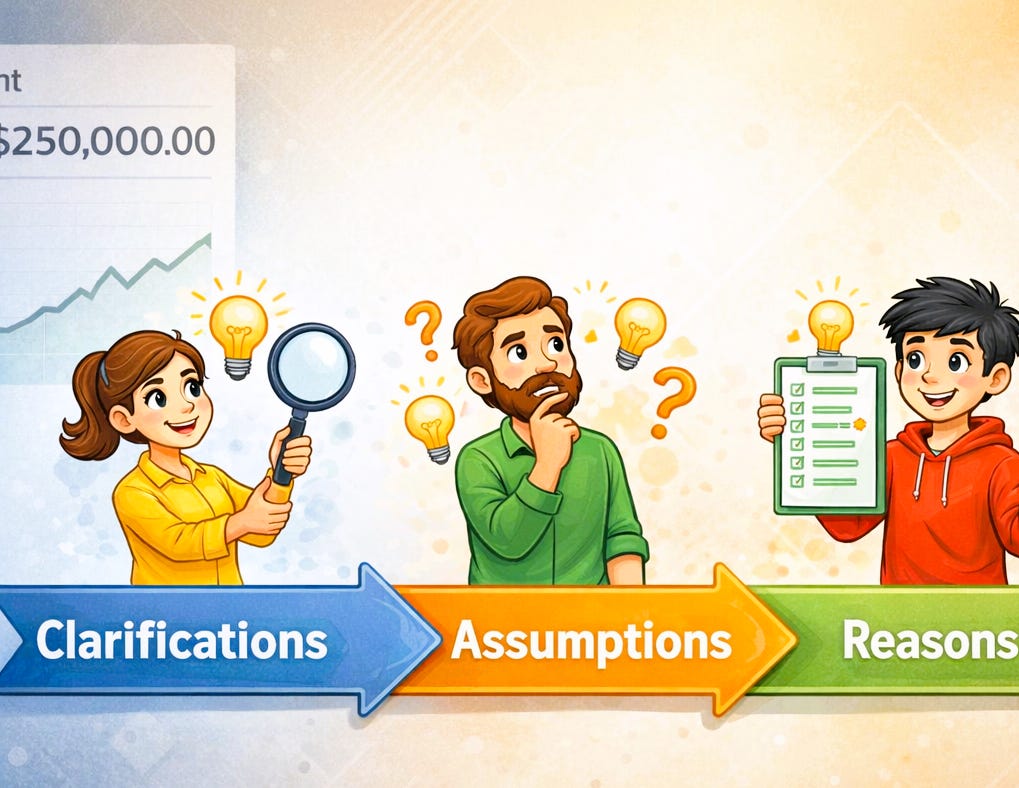
3 Questions to Ponder
Is the C->A->R sequence (Clarifications → Assumptions → Reasons) a habit you have or one you intend to develop?
If you want to build the C->A->R sequence (Clarifications → Assumptions → Reasons) habit, what is your plan and when will you take the first action?
When you present a plan, do you clarify what the key terms mean in this context?
3 Quotes to Ponder
“Self-education is, I firmly believe, the only kind of education there is.”
– Isaac Asimov“Develop into a lifelong self-learner through voracious reading; cultivate curiosity and strive to become a little wiser every day.”
– Charlie Munger“Life ultimately means taking the responsibility to find the right answer to its problems and to fulfill the tasks which it constantly sets for each individual.”
– Viktor E. Frankl
Takeaway
What is one thing you can use from this article and use when you reflect on your career and finances? Share in the comments if you like.
Summary.
The C->A->R sequence in the Financial & Career area are the same questions, just applied to beliefs in this area of life.
Clarifications → Assumptions → Reasons (What supports it?)
The difference between inherited and chosen beliefs lies in your relationship with them.
Examining beliefs helps you genuinely understand and own them.
Try it out on yourself to better understand yourself and practice the method.
What did you learn? What can you improve 1%?
“A few major opportunities, clearly recognized as such, will usually come to one who continuously searches and waits, with a curious mind that loves diagnosis involving multiple variables.”
– Charlie Munger
With the C→A→R (Clarifications → Assumptions → Reasons) sequence in your toolbox your can effectively listen to what others really mean.
The 3 Questions Deep Team
In a world of talking points, your superpower is asking better questions.
Additional Information
Three Questions Deep: Exploring Beliefs
Three Questions Deep: Exploring The Spiritual & Ethical Area
Three Questions Deep: Exploring The Physical & Health Area
Three Questions Deep: Exploring the Learning & Growth Area
Good Morning, Future Self - Let’s Build a Goals Home for “You 2.0”
Good Morning, Future Self- Managing Our “Questioning Habits”


I remember being in my mid 20s talking investing with an older guy at the gym. He gave me the usual lines, buy low, sell high, invest in what you like. At some point I asked him to explain what that actually meant. The conversation fell apart pretty fast. He struggled to explain it, and I was asking questions that were really just trying to confirm what I already believed. Reading this, I can see how a structure like this would have changed that conversation.
Great read, and really appreciate this read.